Watch on YouTube
(Embed)
95
0
Genre: Entertainment
License: Standard YouTube license
Family friendly? Yes

Shared September 3, 2025
Here is a YouTube description tailored for your video, focusing on conceptual clarity without using complex formulas or LaTeX.
Video Title: Master Newton's Laws, Pulleys & Constraints | Complete Physics Breakdown
Description:
Struggling with Newton's Second Law or getting confused by Pulley problems? This video is the ultimate guide to understanding the mechanics of force and motion.
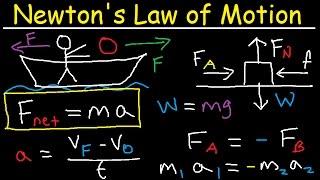
We move beyond simple formula memorization to help you visualize physics. You will learn how to correctly identify systems, draw accurate Free Body Diagrams, and master the tricky concept of "Constraints" in connected bodies.
Shutterstock
Whether you are confused about why tension changes in an accelerating elevator or how movable pulleys distribute force, this lecture covers it all step-by-step.
In this video, you will learn:
The Real Meaning of Newton’s Second Law: Understanding rate of change of momentum and how net force drives acceleration.
Free Body Diagrams (FBD): The most critical step in physics—how to isolate a body and map every external force (Weight, Normal Reaction, Friction, Tension).
The Art of Resolving Forces: How to choose the right X and Y axes to make problem-solving easier.
Constraint Relations: Unlocking the geometric rules that link the motion of connected blocks and pulleys.
Pulley Systems: The difference between fixed and movable pulleys, and how the "two-to-one" rule works in ideal strings.
Shutterstock
Tension vs. Acceleration: Why tension equals weight at constant speed but changes when you accelerate up or down.
The Elevator Problem: Understanding "Apparent Weight" and why weighing scales show different readings when an elevator moves.
Timestamps: 00:00 - Introduction to Newton's Second Law & Momentum
02:38 - How to Draw Free Body Diagrams (FBD)
06:52 - Resolving Forces & Choosing Axes
08:55 - What are Constraints? (Connected Motion)
14:32 - Logic of Strings & Movable Pulleys
20:40 - Real Pulleys: Mass, Friction & Torque
28:31 - Applying Newton’s Third Law to Constraints
39:07 - Types of Forces: Gravity, Normal, Friction & Tension
52:59 - Deep Dive: Mechanics of Overhead Pulleys
01:18:05 - Tension in Accelerating Frames
01:21:31 - Apparent Weight in Elevators Explained
01:33:52 - Summary & How to Approach Problems
Key Concepts Covered:
Newton's Second Law: It is about the Net Force acting on a body.
Constraints: Geometric rules that define how connected parts move relative to each other (essential for pulley problems).
Ideal Strings: Why we assume strings are massless and extensible to keep tension uniform.
Apparent Weight: The difference between the pull of gravity and the Normal Reaction force you actually feel.
Study Tip: Don't just memorize the math! Focus on visualizing the forces. If you can draw the Free Body Diagram correctly, the solution becomes obvious.
#NewtonsLaws #Physics #Mechanics #FreeBodyDiagram #Pulleys #Constraints #JEEPhysics #NEETPhysics #ApparentWeight

597K views


1.2M views

184K views

2.2M views

95 views


7.9K views


